Showing posts with label offshoots symphony. Show all posts

Wednesday, 9 February 2011


It’s been a while since the last blog. I moved house and had a lot of other commitments (including releasing my experimental CD and a concert last October) but have been working on the project intermittently throughout.
.
This has mainly consisted of cleaning up the recordings I made last spring and summer to prepare them for use as source sounds which will become the instruments used for the project. This means taking each recording and removing any unwanted sounds, such as cars, dogs and other incidental sounds as well as hiss/noise from the recording equipment. This can be very demanding and time consuming when working with long files such as those i made of dawn choruses. To do this I first use Steinberg Wavelab (a professional audio editing and mastering environment) to raise the gain (volume) of recordings and remove as much noise as possible using EQ. Most bird sounds fall between 100Hz and 15 KHz so removal of sound below and above these frequencies takes out low level hum and most car sound at the low end and while also removing any anomalous high frequency sounds. I made all of these recording using an Audio Technica AT825 field recording microphone, which is normally used for more near field (closer to the subject) recordings, a pre-amp to boost the gain of the incoming signal and a Fostex FR2-LE field recorder, which makes very good quality, though quite quiet recordings. This resulted in the recordings being quieter than I would have liked with the birds, which were often quite far away from the microphone. When I raised the gain of the recordings I also raised the gain of hiss/noise from the recording equipment. I removed as much of this as possible without distorting the sounds of the birds using Wavelab’s DeHisser. When working with lower frequency sounds such as frogs the process is similar; the recordings are made nearer to the subject so hiss is easier to remove though they are lower frequency so noise like car sounds are more difficult.
.

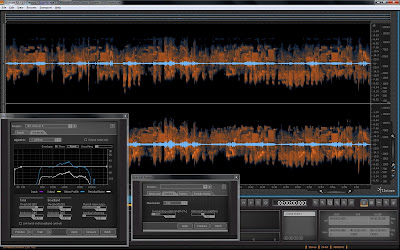
Izotope RX screen shot

...
When I’ve done as much as I can in Wavelab I use Izotope RX (a professional audio restoration software) to clean up remaining noise. This is where things get laborious as each second and often millisecond needs to be carefully examined and cleaned, which when working with files upwards of an hour takes a long time. Using this software I can see not only the volume but the frequency spectrum of all the sounds as a linear graphical representation. I can then use my ears and my eyes to identify issues. The software offers a number of useful tools to correct these issues like being able to isolate and delete very small areas in the frequency spectrum without affecting any other sounds. If unwanted sound occupies the same frequencies as sound you want to keep you can map the unwanted sound by using the Denoiser to analyse areas where the sound is isolated then highlighting the areas where sounds are mixed and just remove what you don’t want, with varying degrees of success. If it is not possible to satisfactorily clean up sounds you can delete small segments of the recording and use spectral repair (at a millisecond level) to reconnect the sounds at either side so you can’t tell they were ever there. This is excellent software which I recommend to anybody considering doing this kind of thing.

.
I have uploaded a 79 minute, 24bit soundscape recording, which I used these processes to prepare, of a dawn chorus made at Offshoots last June called ‘Soundscape 1’ here:

http://www.archive.org/details/LJGregory-Soundscape1offshootsDawnChorusSummer2010

.

It’s not always perfect but i like it and thought you might like it too!

.

This is a 2 minute mp3 clip from 'Soundscape 1'
.


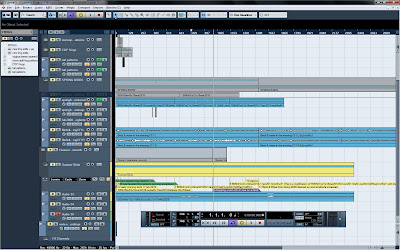
Cubase screen shot


I am now nearing the point where I will begin composition, having cleaned up and prepared all but the bee recordings. I have also begun categorizing them in Cubase and have sympathetically processes some of the frog sounds using CDP (Composers Desktop Project). I have many ideas noted in txt docs regarding composition and arrangement of what i have now decided will be one long piece between 45 and 80 minutes long, depending on ideas, flow and stringent quality control! I hope to have it finished by the end of April/beginning of May.

.

The next (hopefully timelier) blog will be about and feature samples of the work in progress.


Thanks again to everybody who has helped with and taken an interest in this project.

.

You can download and listen to an earlier piece I created from recordings made at the site in February 2008 here:


http://www.archive.org/search.php?query=creator%3A%22Lee%20Gregory%20(Randomlee)%22

.

To listen to my experimental works and pieces for this project as they appear go here:


www.myspace.com/randomleeaudio

.

Read the Preston Citizen article here:


http://www.prestoncitizen.co.uk/leisure/music/8204790.East_Lancashire_musician_s_symphony_of_nature/

.

Follow me on Twitter here:


http://twitter.com/LeeJGregory


Monday, 24 May 2010


This is the second Offshoots Symphony project blog. Since the last instalment i have made recordings of Chris Barber, the rustic wood worker, and his Viking tall lathe and worked on music made of spinning wheels. I have also made a nice poster and earlier this week put together a press release with the help of Lisa Griffin, Offshoots project officer, who has just been really helpful generally, thanks Lisa.


I recorded Chris in the Yurt at Offshoots on the morning of the 7th of May. We recorded in the yurt to minimise external noise (windmills and such!), which was just as well as just as we had finished setting up they started mowing the lawn on the bowling green next door! This was quite audible even inside the yurt so we had to turn everything around to face the opposite direction recording, using a direction mic to cut out the noise (small amounts of extreanious noise are removable in the studio). I made recordings of Chris using his Viking Tall Lathe and chopping and splitting wood. The tall lathe provided some good rhythmic sounds and varied as more of the wood was cut away, becoming smoother and more fluid and we got some good crisp sounds from the wood splitting.


.

Viking Tall Lathe raw audio mp3

.

I have also been working on music using the recordings of spinning wheels discussed in the last blog. The double treadle has a harsher sound with more percussive elements than the single treadle which is more ambient and has a longer, more drawn out rhythm. This will be down to the natural rhythm and spinning speed of the operators as much as the wheels themselves. After cleaning up the recordings (removing unwanted noise) i loaded all the recordings onto separate stereo tracks in Cubase (a software sequence/recording environment) then reviewed them individually choosing parts to work with, based on how the sounds felt and worked rhythmically, then removing the left-over sounds and manually (and minimally) quantizing (tightening up the rhythmic elements by moving them forward or backward in time slightly) the parts i had chosen to make them work better musically over time. These parts then become loops and breaks that will form the initial frame of the piece.


The piece will work by developing a number of spinning rhythms that will begin in the centre of a surround sound environment then lift off and pan around the space intersecting with each other to create rhythms within rhythms. i don’t want the piece to be too harsh rhythmically so i will use eq, and volume curves to soften the harsher elements . There will also be recordings of carders used incidentally during the piece.


Spinner work inprogress mp3 clip


Currently i plan to use this spinning track (provisionally called ‘Spinner’) and another rhythmic piece creates using the rustic wood working recordings i made with Chris at either end of a more expansive bird piece which will form part of each of them intertwining with their rhythms as it begins and ends.

In the coming weeks i will be making more recordings of birds as the soundscape has now changed since i last recorded (most notably by the blackbirds and swallows) and will finish the spinning piece.

On the 12th of August there will be a Wildthings sounds art workshop, as part of the Wildthings summer family days. Wildthings is a monthly kids club at offshoots run by my wife Joe and for this we will be working together, making recordings with the kids as well as other activities yet to be finalised; more info in the next blog.

.

You can download and listen to an earlier piece i created from recordings made at the site in February 2008 here:

http://www.archive.org/search.php?query=creator%3A%22Lee%20Gregory%20(Randomlee)%22

.

To listen to my experimental works and pieces for this project as they appear go here:

www.myspace.com/randomleeaudio

.

follow me on Twitter here:

http://twitter.com/LeeJGregory

.

Again thanks to: Joe, Phil, Lisa, Chris, Alan, Jackie, Eddie, and all at Offshoots, the birds, frogs, bee’s and bats for their ongoing help, support and enthusiasm for this project.